Historic Quarters
Henley-on-Thames
The Georgian riverside market town that hosts the Royal Regatta — a whole day of bridge, church, riverbank, boat trip and long lunch.
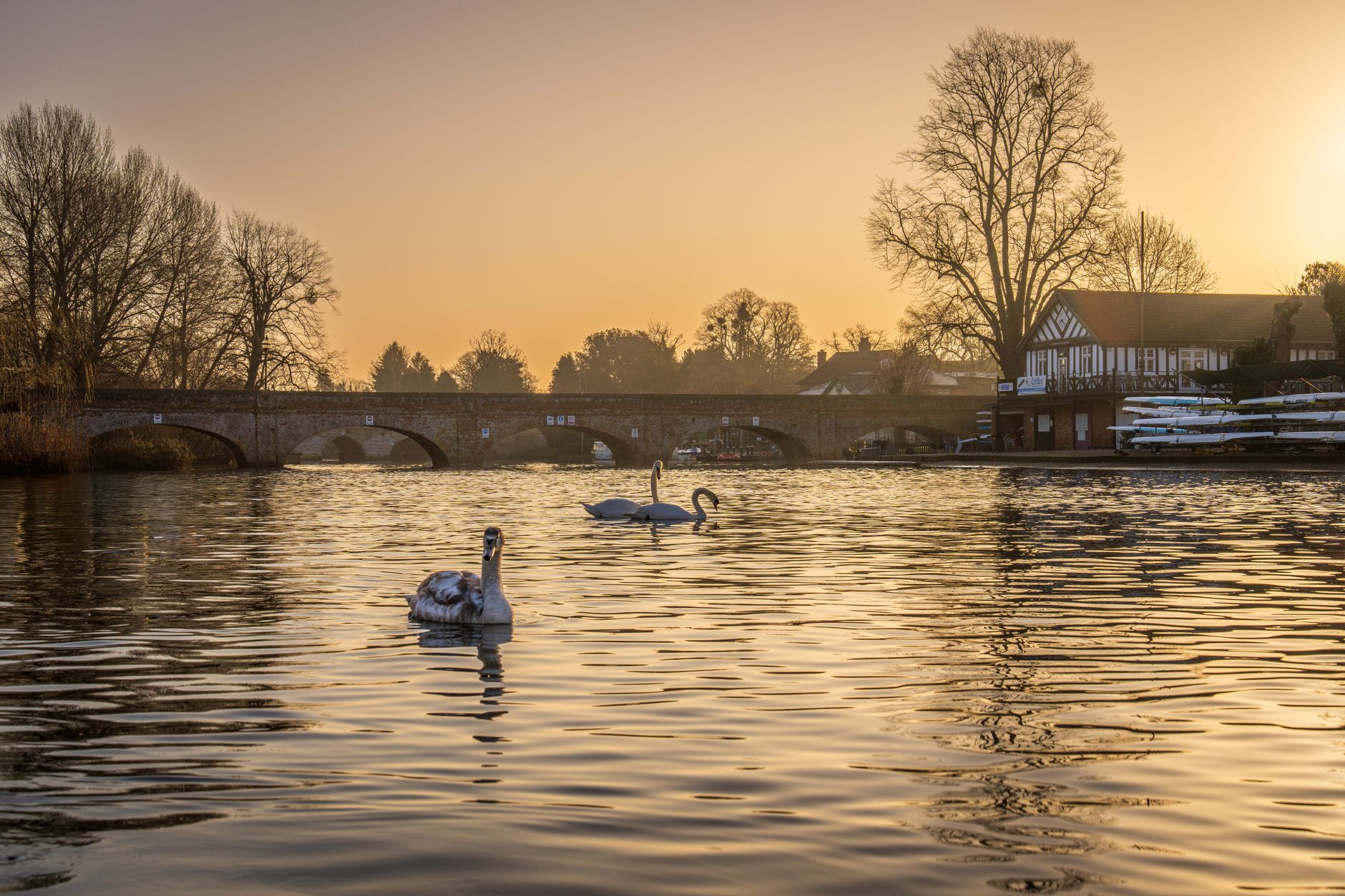
Henley-on-Thames is nine miles north of Reading, a Georgian and Victorian market town on a beautiful stretch of the river between the Chiltern Hills. It has been famous since 1839 for the Royal Regatta, held for five days in early July, when the population triples and the mile-and-a-half straight reach becomes a wall of umpire launches, blazers and Pimm's. Outside regatta week it is a quieter, extremely walkable town: an elegant 1786 stone bridge, the medieval tower of St Mary's Church, Georgian shopfronts on Hart Street and Bell Street, and a long meadow riverbank where you can sit and swan-watch for free.
The river frontage is the star: cross the bridge to Remenham on the Oxfordshire bank for the best view back at the town. The River & Rowing Museum on Mill Meadows is a proper little institution, with the Wind in the Willows gallery for children (Kenneth Grahame lived nearby at Pangbourne). Hobbs of Henley run passenger boat trips from the town quay Easter to October — the 45-minute Marsh Lock circuit is £13 and lovely. Hart Street has independent bookshops, a proper cheesemonger and a Saturday farmers' market at the town hall.
20 minutes by train from Reading, changing at Twyford onto the Henley branch line. Free to explore, pay for museum and boats. Come out of Regatta week unless you want the show; late April and September are perfect. Book The Angel on the Bridge for lunch on the water. Combine with Greys Court, four miles inland, for a heritage-plus-town day. Parking in town is metered and full by 11:00 — the train is much easier.
The town walk itself is short and rewards slow legs. From the station it is five minutes up Station Road and Thames Side to the bridge, whose arches carry the carved keystone heads of Thames and Isis cut by Anne Seymour Damer in 1786; the footway is narrow and the traffic constant, so take the photograph from the Remenham bank rather than the parapet. Behind the bridge, St Mary's chequerwork flint tower of around 1520 rises over a churchyard of table tombs and almshouses — free to enter, ten minutes inside. Next door the timber-framed Chantry House is among the oldest buildings in town and opens only on limited days, so go in if the door is propped. Hart Street runs west to Market Place and the 1901 town hall; Bell Street has the Bell Bookshop; New Street holds the Kenton Theatre of 1805, one of the oldest working theatres in England, and the old Brakspear brewery buildings, brewing having left for Witney in 2002.
Give the River & Rowing Museum ninety minutes and no more. The rowing galleries are the reason to pay: racing shells hung at eye level, an Olympic-winning coxless four from Sydney 2000, and a clear explanation of why the Henley reach — a straight, sheltered mile and 550 yards from Temple Island — became the sport's most famous water. The Thames gallery follows the river source to sea, the Henley gallery covers regatta and town history, and the Wind in the Willows walk-through is genuinely charming if you are five and mildly twee if you are not. The café overlooks Mill Meadows. Afterwards walk the towpath: fifteen minutes south from Mill Meadows brings you to the wooden causeway at Marsh Lock, the single best free thing in Henley; northwards on the Berkshire bank it is 25 minutes to a view of Temple Island and about an hour to Hambleden Lock. Do the causeway early, before the coach parties.
Getting here from Reading is a two-train job and still faster than driving. Great Western services run Reading to Twyford in five to nine minutes, then the Henley branch shuttle takes ten to thirteen minutes; reckon on 20 to 25 minutes end to end, roughly half-hourly, with an off-peak return around £9. The branch thins in the late evening, so check the last connection at Twyford before you order a second bottle. Carousel Buses route 800 links Reading with Henley, Marlow and High Wycombe roughly hourly — cheaper, but 50 to 60 minutes each way. Drivers take the A4155 through Playhatch and Shiplake, nine miles in 25 to 35 minutes. Greys Road is the biggest car park and the only one with a realistic chance of a space after 11:00; Mill Meadows is closest to the museum; both are pay and display at roughly £2 an hour. On regatta days, do not drive at all.
Costs are easy to control because the best of Henley is free. The town, riverbank, churchyard and towpath cost nothing; the museum is £14 an adult, with children and concessions less; Hobbs boat trips run £13 for the 45-minute Marsh Lock circuit up to about £25 for longer downstream cruises, and self-drive hire is charged by the hour and climbs quickly. A pint on the water is £6 to £7 and lunch £15 to £40 a head, with tasting-menu cooking in town pushing well past that. Greys Court is about £13 an adult and free to National Trust members. Regatta week is the expensive exception: a public Regatta Enclosure day badge is around £30, more at the weekend, the Stewards' Enclosure is members and guests only with a strict dress code, and hotel rates at The Relais Henley or the Red Lion Hotel roughly triple. Two people doing museum, boat and lunch spend about £110 including trains.
Timing matters more here than ticketing. Arrive by 10:00 and you get the bridge, the church and the towpath to yourself; the town properly wakes at about 10:30, the first boats leave late morning, and Hart Street is at its worst between 12:00 and 15:00 on a Saturday, when no restaurant will seat you without a booking. By month: late April and May are the sweet spot, cool and uncrowded with blossom on Mill Meadows; from mid-June the reach fills with regatta scaffolding and marquees, which is either atmospheric or an eyesore; the first week of July is chaos; mid-July brings the black-tie Henley Festival on its floating stage; August is day-tripper heavy; September is arguably the best month of all, with the Literary Festival following in late September and early October. November to February the river runs high, the towpath turns to mud, and Hobbs trips stop — come for the December Living Advent Calendar evenings instead.
It suits families with under-tens, walkers, and anyone who wants a long lunch with water in view; Mill Meadows and the riverside promenade are flat and paved, and the museum has level access and lifts, though Hart Street's pavements are narrow and the Marsh Lock causeway is worth checking before you commit a wheelchair to it. Teenagers need a boat or a paddleboard to stay interested. With one hour before a train, do bridge, churchyard and a drink at The Angel on the Bridge and skip the rest. Fold in Greys Court four miles inland, Stonor Park five miles north, or Marlow seven miles downstream, and stop at Sonning on the drive back to Reading. The honest caveats: the shopping is boutiques and estate agents rather than bargains, nothing is cheap, and the Regatta is not a free public party — the racing is visible from the Berkshire towpath, but the party behind the fences is not for passers-by.
Hours & entry
Free town; individual attractions ticketed
Town centre daily · River & Rowing Museum daily 10:00-17:00 · Boat trips Apr-Oct
What to see
{'what': 'The 1786 stone bridge over the Thames', 'where': 'Foot of Hart Street, connecting town to Remenham'}
{'what': 'River & Rowing Museum with Wind in the Willows gallery', 'where': 'Mill Meadows, 5 min walk south of the bridge'}
{'what': 'Hobbs of Henley boat trip round Temple Island', 'where': 'Town quay, opposite Hart Street'}
Tips from the ground
Avoid the first week of July (Regatta) unless you have tickets — town is packed and hotels triple.
The Angel on the Bridge has the best waterside terrace for a pint; book their food at least a day ahead.
Train + walk is far easier than driving; town car parks are full by 10:30 on weekends.
Questions, answered
Cost?
Town free. River & Rowing Museum £14 adult. Boat trips £13-25. Lunch £15-40 per head. Add an off-peak return train from Reading at around £9, a pint on the water at £6-7, and pay-and-display parking at roughly £2 an hour if you drive. Greys Court, if you fold it in, is about £13 an adult and free to National Trust members. Two people doing the museum, a 45-minute boat trip and a sit-down lunch spend about £110 all in. Regatta week is the outlier, with public enclosure badges around £30.
Free entry?
Yes — the town, riverbank and church are all free to wander. That includes Mill Meadows, the whole town quay frontage, St Mary's churchyard with its almshouses, the walk over the bridge to the Remenham bank, and the towpath south to the wooden causeway at Marsh Lock, which is the best fifteen minutes in Henley and costs nothing. Even in regatta week you can watch racing free from the Berkshire towpath. Only the museum, the boats, the theatre and the food take money.
How long?
Half a day easy, full day if you add a boat trip and long lunch. Budget roughly 40 minutes for the bridge, church and Hart Street, 90 minutes for the River & Rowing Museum, 45 minutes for the Marsh Lock boat circuit, an hour or more for lunch and another hour for the towpath walk. With only 60 minutes before a train, do the bridge, the churchyard and a drink at The Angel on the Bridge, and leave the museum for another day.
Closed times?
Nothing closes as a town; individual venues close Christmas Day. Regatta week (early July) makes the centre chaotic. Hobbs passenger trips run Easter to October only, so November to March there is no boat at all. St Mary's can be shut for weddings and services, the Chantry House opens on limited days, and some restaurants close Sunday evening and Monday. In a wet winter the towpath towards Hambleden floods and turns to mud — bring boots or stay on the paved promenade.
Booking?
Book waterside restaurants and boat trips ahead in July and August. The Angel on the Bridge wants a day or two's notice midweek and closer to a week for Sunday lunch; Hobbs tickets can be bought at the quay kiosk but weekend afternoon departures do sell out. The museum needs no booking. Accommodation is the real pinch point: for regatta week, riverside rooms at The Relais Henley or the Red Lion Hotel go months ahead at roughly triple the usual rate.
How do I get there from Reading?
Train from Reading with change at Twyford, about 20-25 minutes. Trains half-hourly. Reading to Twyford is five to nine minutes, then the Henley branch shuttle ten to thirteen; an off-peak return is around £9 and the station is a five-minute walk from the bridge. Carousel Buses route 800 is the slow alternative, roughly hourly and 50-60 minutes. Driving means the A4155 through Playhatch, nine miles in 25-35 minutes, then hunting a space at Greys Road. Check the last evening connection at Twyford before settling in.
Doing good is the business: every booking through Stay Reading funds one verified tonne of carbon removal — same room, same price, no markup.
Start your search